Español
 العربية
 Francés
 Русский
 Português
 Deutsch
 日本語
日本語
 한국어
한국어
 Việt
Việt
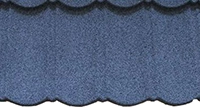
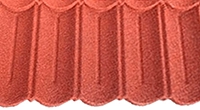

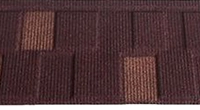
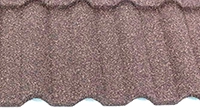
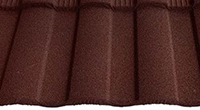
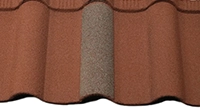
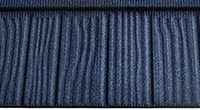

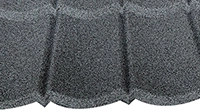


Inside a Stone Coated Metal Tile: How the Steel, Coating, Primer, and Stone Granules Each Do Their Job
Inside a Stone Coated Metal Tile: How the Steel, Coating, Primer, and Stone Granules Each Do Their Job
Most people look at a stone coated metal roof tile and see a colored surface. That's fair, because the color is the first thing you notice from the street. But a good tile is not one layer pretending to do everything. It's four layers, each doing a different job, and the difference between a roof that holds up and one that starts shedding bits of itself after a few years is almost always hidden inside, where you can't see it until you cut one open.
So let's cut one open. At FUODE ROOFING we make stone coated metal roof tiles and the steel coils they're formed from, which means we sit on both sides of the question: the material that goes in, and the tile that comes out. When someone asks what makes one tile better than another, we don't point at the color. We walk them through the cross section, layer by layer, because that's where the truth lives.
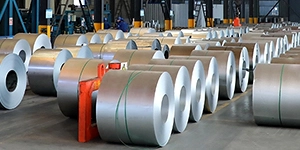
The backbone is the steel. In our tiles that's a 0.55mm steel base, and this is the part that gives the tile its strength and its shape. It has to be stiff enough that the tile doesn't flex and drum underfoot, strong enough that it doesn't dent when someone walks on it during installation or when hail comes down, and it has to hold the pressed profile, the waves and stiffening ribs, without springing back. There's a reason the first question any experienced roofer asks is how thick the steel is. Thin steel feels flimsy in the hand, and it stays flimsy on the roof. When we set up a production line, we don't try to shave the gauge down to save a few cents per sheet, because that saving comes right back as a problem a few years later, and by then it's your problem, not ours.
But steel alone doesn't survive outdoors, and this is where the second layer comes in. Bare steel rusts, and it rusts fast. So the base metal carries a corrosion coating, and in our case that's a galvanized or alu-zinc coated surface, a layer of zinc, or zinc and aluminum, applied at the steel mill before the coil ever reaches our press. The clever part is how it works. Zinc doesn't just sit on top of the steel like paint. It's what people call a sacrificial coating: when a scratch cuts down to the steel, the zinc around that scratch corrodes first and protects the exposed steel underneath. That's the difference between a coating that delays rust and a coating that fights it. Alu-zinc takes that a step further, adding the barrier protection of aluminum to the edge protection of zinc, which is why it shows up on a lot of good roofing steel. What you don't want is a coating so thin you can barely measure it, because then you're not really buying protection, you're buying the idea of protection.

The third layer is the one nobody ever sees, and it might be the most honest part of the whole tile. On top of the steel, before anything else goes on, there's a primer. It sounds boring, and it is, and that's exactly why it matters. The primer does two things. It seals the metal surface so moisture doesn't get a foothold, and it gives the stone granules something to actually grab onto. Think of it as the glue that keeps the next layer stuck on for the next few decades. When a manufacturer skips a proper primer coat, or uses something cheap that barely adheres, you don't usually notice at first. The tile looks fine in the box. But a year or two of sun and rain will expose it, because the granules start coming loose, first around the edges, then across the face. A tile that loses its stone is a tile that's lost its job.
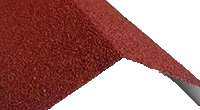
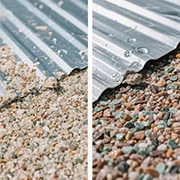
And then there's the layer everyone judges the tile by: the colored stone granules on top. Those granules are small pieces of natural stone, usually basalt, that get coated with a ceramic color and baked, so the color is part of the granule itself, not just paint sitting on the surface. That's a detail worth sitting on for a second. Colored sand that's simply dyed will fade, because the dye is only on the outside. A baked ceramic coating becomes the granule. That's the difference between a roof that still looks right after years of strong sun and one that turns chalky and washed-out. The granules also carry the texture and the protection. They take the UV beating, they break up the heat of the sun, they give the roof its non-glare finish, and they're what makes the tile read like a traditional shingle or slate from the curb even though it's metal underneath.
So when you stack those four layers up, steel for strength, zinc or alu-zinc for corrosion, primer for bonding and sealing, granules for color and weather, you start to understand why two tiles that look identical from the ground can behave completely differently on a roof. The visible layer tells you the color. The three layers underneath tell you how long that color is going to stay there, and whether the roof is going to stay sound. That's the whole game.
The layers also matter differently depending on where the roof sits, which is a conversation we have a lot because our tiles go to Europe, Central Asia, West Africa, and Southeast Asia. Near the coast, the coating and the sealed edges are the layers doing the heaviest lifting, because salt air is relentless with bare metal. Under strong sun, the granule color and the primer are what keep the tile from fading and shedding. In cold climates with freeze and thaw, it's the way the layers move together that counts; a tile built with mismatched materials will separate, while one with a proper primer holds together through the cycles. None of this shows up in a brochure photo. It all shows up in the cross section.
There's also a side to this that only makes sense once you've stood on a production floor. Every one of those four layers can be done well or done badly, and the difference is decided on the line, not in the lab. When a coil of steel is fed into the press, the dies have to form the waves and ribs without cracking or thinning the coating, because a hairline crack in the zinc is a place where rust will start and spread. When the granules are applied, they have to go on evenly, because a patch where the primer is bare is a patch that will fade faster than the rest of the roof. That's why our quality checks walk the same order as the layers: gauge going in, coating weight on the coil, primer coverage before the stone, and granule adhesion after it. It's not glamorous, but a tile is only as consistent as the weakest pass it went through.
Now, a factory owner is going to tell you to look at his process, and I get that it sounds like a pitch. So here's what you can actually check yourself. Take a tile and cut off a corner, or just bend it a little. Look at the edge. You want to see a clean steel core with a uniform coating wrapped around it, not a raw edge that looks like it was sheared and left alone. Rub your palm across the surface and then look at your hand. A little dust is normal; a palmful of loose granules is not. Knock on the tile with a knuckle. A good tile sounds tight and solid, like a piece of steel should. And ask for the gauge. If someone can't or won't tell you the thickness of the steel, that's an answer in itself.
This is also where being a source factory becomes a real advantage, and not just a talking point. Because we make the steel coils and we run the whole line, we're the ones choosing the gauge, the coating weight, the primer, and the granules for every tile that leaves our factory. We're not buying finished tiles from someone else and reselling them with our name on the box. If there's a problem, we find it at the source, not in a container sitting on the water. That's a different kind of accountability, and in an industry where a lot of buyers get burned by bad batches, it tends to matter.
If you're comparing tiles from different suppliers, and I expect you are, here's my honest advice: don't compare the brochures, compare the cross sections. Ask what's under the color. A stone coated metal tile is only as good as its weakest layer, and the weakest layer is usually the one that's cheapest to skip. We'd rather show you exactly what's in our tile and let you decide than convince you with words we can't back up.
One more thing worth asking for, and it costs nothing: the specs in writing. A supplier who can tell you the steel gauge, the coating weight, and the primer system, and who will put those numbers on paper, is a different kind of partner than one who only talks about how good the product is. You don't have to be an engineer to use that information. You just have to want to know what's under the color, because that's the part of the roof that decides how long the roof lasts.
If you want to check us on that, the easiest way is to ask for a sample, cut it, bend it, and see for yourself. We're FUODE ROOFING, a factory in Liaocheng, Shandong, and we're happy to talk through the layers, the coating weights, the gauge, whatever you want to know about how a stone coated metal roof tile is actually built. Get in touch and we'll take it from there.

— FUODE ROOFING —
Stone Coated Metal Roofing Source Factory | Shandong, China
www.fuode.com | Welcome factory visit & sample requests