Español
 العربية
 Francés
 Русский
 Português
 Deutsch
 日本語
 한국어
 Việt



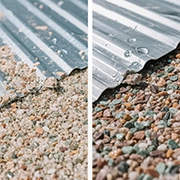




Stone Coated Roofing Sheet Specifications to Check
Stone Coated Roofing Sheet Specifications Buyers Should Check
A specification sheet is the reference point for almost every later conversation: the quotation, the sample evaluation, the inspection and the site take-off. When two suppliers quote different numbers, the difference is often a difference in specification rather than a difference in price. This article lists the fields that belong on a stone coated roofing sheet data sheet and explains how each one is used.
Steel substrate and metallic coating
The substrate is usually a coated steel sheet with an aluminium-zinc metallic layer. Three fields matter: base steel thickness, the type of metallic coating, and the coating mass expressed per square metre. Thickness influences stiffness and the fixing behaviour; coating mass is one of the inputs that a specifier reviews for corrosion exposure, particularly near the coast.
Ask for the tolerance on nominal thickness as well as the nominal value. A data sheet that states a single number without a tolerance makes an incoming inspection difficult to define. Test method references belong here too, and our certificates guide explains how to read them.

Tile size versus effective coverage
Physical tile size and effective coverage are different numbers, and confusing them is a frequent cause of short orders. Because tiles overlap at the head and the side, the area of roof actually covered by one tile is smaller than the tile's length multiplied by its width.
Typical export figures often cited in the trade are a length near 1,300–1,400 mm, a width near 400–430 mm, and an effective coverage in the region of 0.45–0.50 m² per piece, depending on the profile and the specified overlap. The take-off calculation is:
Required tiles ≈ roof area ÷ effective coverage per piece + wastage allowance
Wastage depends on roof geometry. A simple gable roof uses less than a roof with several hips, valleys and dormers. The installation guide and the accessory checklist cover the other quantities that belong in the same take-off.
Thickness and weight per square metre
Weight is usually reported per piece and per square metre of installed roof. The second figure is the one a structural engineer needs. Trade ranges commonly fall around 2.5–3.3 kg per tile, which places stone coated metal roof tiles well below many clay or concrete alternatives on a per-square-metre basis.
Weight also drives freight. A container may reach its volume limit before its payload limit, or the reverse, depending on thickness and packing density. That is why weight per square metre appears again in container loading calculations.
Packing data and pieces per pallet
Packing fields are often missing from a first quotation, yet they change the landed cost. Request:
Field | Why it matters |
Pieces per carton or bundle | Handling and site distribution |
Pallet dimensions and height | Container loading plan |
Pallets per 20GP or 40HQ | Freight per square metre |
Interlayer or surface protection | Granule damage in transit |
Carton marking and batch code | Pre-shipment sampling |
Our lead time article shows where packing sits in the overall schedule, and the quotation comparison guide shows how to fold packing data into a like-for-like cost table.
How to build a specification sheet
A usable data sheet names the profile, states each field with a unit and a tolerance, references the test method where relevant, and carries a revision date and document number. Ask that the revision be quoted in the purchase contract, so the goods are inspected against the same version that was priced.
For OEM buyers, add the approved colour blend reference, the carton artwork version and the retention sample ID. That turns a generic data sheet into a document that actually governs the order. If you are still at the sampling stage, the sample evaluation routine is a useful companion.
Frequently Asked Questions
Why is effective coverage smaller than tile size?
Because each tile overlaps the one below and beside it. Only the exposed portion covers new roof area, so the overlap must be subtracted when calculating quantities.
Which thickness should be specified?
It depends on the profile, the batten spacing and the local wind conditions. Use the supplier's current data sheet and the project engineer's requirement rather than a generic figure.
Should the data sheet include accessory dimensions?
Yes. Ridge caps, valley trays and barge boards are ordered by linear metre, so their coverage and length should be listed alongside the field tiles.

Visit www.fuode.com for more details.
— FUODE ROOFING —
Stone Coated Metal Roofing Source Factory | Shandong, China
www.fuode.com | Welcome factory visit & sample requests