Español
 العربية
 Francés
 Русский
 Português
 Deutsch
 日本語
 한국어
 Việt






Inside a Stone Coated Roof Tile Factory: From Steel Coil to Packed Pallet
Inside a Stone Coated Roof Tile Factory: From Steel Coil to Packed Pallet
Buyers often ask whether a supplier is a real factory or a trading office with a catalogue. One of the simplest ways to tell is to understand the production sequence well enough to ask specific questions about it. This walkthrough follows stone coated metal roof tiles through a typical stone coated roof tile factory, from incoming coil to the pallet that gets loaded into a container.
Raw material intake and steel preparation
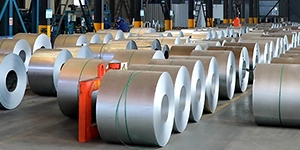
Production begins with coated steel coil. The incoming material is checked for width, thickness, coating mass and surface condition, and each coil is logged against a batch number. Traceability here matters: if a colour or adhesion issue appears weeks later, the coil reference is what allows the factory to isolate the affected batch.
The coil is levelled and cut to the blank size required by the profile. Blanks that are out of tolerance create problems later at the overlap, so thickness and flatness are usually measured at this stage rather than only at final inspection.
Pressing the tile profile
Blanks move to a press equipped with a profile-specific mould. The pressing step forms the ribs, steps and interlocking edges that give the tile its shape and its water-shedding geometry. Tooling is profile-specific, which is why a factory's catalogue of available shapes is a reasonable indicator of how many mould sets it actually holds.
After pressing, the tile passes through a washing and pre-treatment stage so the coating system bonds to clean metal. Skipping or shortening surface preparation is one of the common causes of poor adhesion later, which is why it appears early in our quality control checklist.

Basecoat, stone chip application and curing
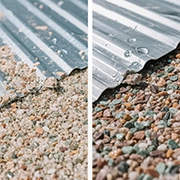
A primer and an acrylic basecoat are applied to the formed tile. Stone granules are then distributed across the surface while the basecoat is still wet. Excess granules are recovered and recirculated, and the tile surface is checked for even coverage before it enters the oven.
Curing is a time-and-temperature process, not just a drying step. If the line runs faster than the coating system allows, adhesion and granule retention suffer. Asking a supplier about line speed and oven length is more informative than asking whether they "have a production line". The OEM/ODM article explains how colour blends are changed on the same line without disturbing the approval record.
Oven curing, topcoat and colour consistency
After the main cure, a clear or pigmented topcoat is applied and cured again. Colour is checked against a retained master sample under consistent lighting. Small shade variation between batches is normal for a mineral granite finish; what buyers should expect is a documented tolerance and a sealed reference sample for each approved blend.
A factory that keeps retention samples for both the raw chips and the finished tile is usually easier to work with on repeat orders, because year-two shipments can be compared with year-one records.
Inspection, packing and container staging
Finished tiles are inspected for dimensional accuracy, surface coverage, edge condition and fastener hole position. Packing method matters more than it may appear: tiles are usually stacked in cartons or on pallets with interlayers to protect the granule surface, and pallet dimensions drive the container loading plan.
At the staging area, cartons are marked with profile, colour, quantity and batch reference. That marking is what a pre-shipment inspector uses to sample the right lots. Our article on production capacity and lead time shows how these steps translate into a delivery schedule.
What to ask during a factory walkthrough
· Which steps are performed in-house and which are outsourced?
· How many profile mould sets are held on site?
· How are coil batches and finished-goods batches linked?
· Where are retention samples stored, and for how long?
· What does the packing line do to protect the granule surface?
A supplier that can answer these without reading from a brochure is generally easier to audit. For a wider verification framework, see how to verify a stone coated roof tile manufacturer in China.
Frequently Asked Questions
Can a factory produce several profiles at once?
Usually each press runs one profile at a time, so profile changes require a tooling changeover. This is one reason mixed-profile orders need a realistic production schedule.
Why does curing time affect delivery dates?
The coating system needs a defined time at a defined temperature. Line output is therefore bounded by the oven as well as by the press, which is why capacity claims should be checked against the actual line layout.
Are stone chips applied before or after pressing?
After pressing. Applying granules to a formed tile requires the basecoat to be on the finished surface, so the sequence is press, prepare, coat, chip, cure.

Visit www.fuode.com for more details.
— FUODE ROOFING —
Stone Coated Metal Roofing Source Factory | Shandong, China
www.fuode.com | Welcome factory visit & sample requests