Español
 العربية
 Francés
 Русский
 Português
 Deutsch
 日本語
 한국어
 Việt






Wind Resistance of Stone Coated Roofing in High-Wind Regions
Wind Resistance of Stone Coated Roofing in High-Wind Regions
Wind damage on tiled roofs rarely starts in the middle of the field. It starts at a corner, an eave, a ridge termination or a gable edge, where local suction is highest and where a single missing fastener can begin a progressive failure. Understanding that pattern is more useful to a buyer than a single wind-speed number, because it explains why the same tile can perform well on one roof and poorly on another.
Where wind load acts on a tiled roof
Aerodynamic pressure on a low-rise roof is not uniform. Uplift concentrates in three zones:
· Corners and gable edges, where flow separates and suction peaks.
· Eaves, where the wind is forced over the edge and the pressure differential is largest.
· Ridge and hip terminations, where the covering changes direction and the fixing is interrupted.
The interior field experiences lower suction and is usually the last area to fail. This is why installation manuals specify a denser fastener pattern at perimeters. If a crew applies one fixing pattern across the whole roof, the roof is under-fixed exactly where it matters.
Interlocking profile and overlap design
A stone coated tile resists uplift through its geometry. The side lap and head lap create a continuous surface, and the interlock restricts the edge of one tile from lifting out of plane. Profile depth, rib shape and the number of locking points all contribute.
Overlap is a design variable with a cost consequence. More overlap raises resistance but consumes more tiles per square metre, because effective coverage falls. That trade-off should be resolved in the specification, not on the roof: the specification sheet should state the overlap that the quoted coverage assumes.
Fasteners, battens and edge zones
The fastening system is where wind performance is either delivered or lost.
1. Use the specified screw type and length for the batten material.
2. Fit the washer correctly; an overdriven screw compresses the washer and creates a water path.
3. Fix into the batten, not into the gap beside it.
4. Apply the denser perimeter pattern defined in the manual.
5. Check that battens are fixed to the structure, not only to each other.
Batten spacing and fixing are often outside the tile supplier's scope, yet they determine whether the tile's capacity can be used. The installation guide sets out the sequence, and the accessories article covers ridge and edge fixings.
Ridge, eave and hip details
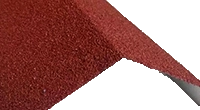
Terminations are the weakest link because they interrupt the interlock. A ridge cap relies on its own fixings and on the closure beneath it. A barge board or verge trim must be fixed through the covering into structure. A valley has to accommodate both water flow and movement.
Two failures are common in inspection: a ridge cap fixed only at alternate positions, and an eave course with no additional fixing despite being in the highest-suction zone. Both are visible from a ladder, which makes them a cheap pre-handover check.
Test reports and project-specific engineering
Wind performance data is meaningful only when the test assembly is described. A report should state the profile, the substrate, the fixing pattern and the support spacing that were tested. A result obtained with a denser pattern than the one being installed does not describe the roof being built.
For a specific building, the design wind pressure comes from the local code, the terrain category, the building height and the roof geometry. That calculation is engineering work, and it belongs to the project engineer rather than to the tile supplier. The supplier's contribution is the tested assembly and the installation manual; the engineer's contribution is the site-specific demand. Buyers in storm-exposed markets should ask for both, and should treat "tested" and "suitable for this site" as two separate questions.
Frequently Asked Questions
Does a heavier tile resist wind better?
Not by itself. A mechanically fixed, interlocked tile relies on the fixing pattern and the profile. Mass helps only where the design depends on dead load, which is not how this product is fixed.
How many fasteners per tile should be used?
It depends on the profile, the batten spacing and the zone of the roof. Use the current installation manual and the engineer's specification rather than a generic number.
Is a stone chip surface relevant to wind performance?
It is a surface finish. Uplift behaviour is governed by interlock, overlap, fasteners and detailing, not by the granule layer.
— FUODE ROOFING —
Stone Coated Metal Roofing Source Factory | Shandong, China
www.fuode.com | Welcome factory visit & sample requests